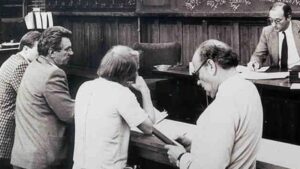
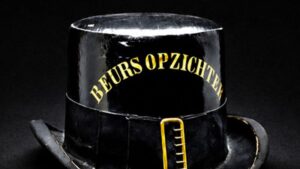
Rokin 65Rokin 65 is the second home of the Amsterdam Options Exchange. After the former grain exchange hall in the Beurs van Berlage (see 10) had become too small, the option traders moved to this building in 1987, which was specially designed for them by architect Cees Dam.
The options exchange experienced an unprecedented boom here, and with around eight hundred traders on a floor measuring 900 square metres, it was soon bursting at the seams. A merger with the stock exchange on 1 January 1997 brought a solution. The trade in shares and bonds was already fully automated, freeing up the large trading hall at Beursplein 5 (see 11). In 1998, options traders in brightly coloured jackets took over the floor, until they too switched to full screen trading in 2002.
After a major renovation, Rokin 65 is now home to NRC Handelsblad, a newspaper that has been connected to the Amsterdam stock exchange since 1883.
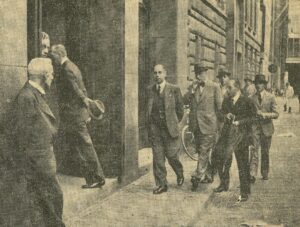
1987 - 1998Beursplein 5Beursplein 5 is the fourth stock exchange location in Amsterdam and the first private residence of the stock exchange. After a festive opening on 22 December 1913, the trading started on 2 January 1914. After three centuries of 'co-existing’ with the merchants in the municipal Merchants Exchanges, a long-cherished wish came true: a separate building as the basic condition for the healthy growth of the stock exchange.
The building is the most important secular building by the more commonly known church-designing architect Jos. Th. Cuypers. And this is visible in the building itself. The many crossbows in the building’s design regularly make visitors think they are in a church.
For eighty-five years, Beursplein 5 was the exclusive domain of the Vereniging voor de Effectenhandel and trade in bonds and shares. Shortly before the turn of the century, this changed with the automation of the stock exchange. In 1998, following a merger, the options exchange took over the stock market's vacant trading room. But soon after, the options exchange also followed the trend of digitisation and in 2002, after 400 years, Amsterdam's floor trading finally came to an end.
Beursplein 5 still occupies a central place in the Dutch financial industry today. Euronext is still the building’s main occupant. Many exchange-related institutions are located in the monumental building designed by Jos. Th. Cuypers. These include, for instance, traders who participate in today's digital market trading from behind their screens, but still on the trading floor.
1913Beurs van BerlageAfter the Beurs van Hendrick de Keyser (see 5) and the Beurs van Zocher (see 9), the Beurs van Berlage was the third municipal Merchants Exchange location in Amsterdam. After a struggle of over thirty years (called ‘De Beursquaestie’), the building finally opened its doors in 1903.
For the first time in the history of the exchange, the markets were separated. In addition to the large goods exchange hall, the grain and stock traders also had their own floor. The Vereniging voor de Effectenhandel (Stock Exchange Association or ‘VvdE’) finally had its way: separate rooms for the stock traders. But this was only an interim step. The stock trade continued to grow and the hall soon became too small. Therefore, at the end of 1913 and to the displeasure of the municipality, the decision was made to move to their own stock exchange location: Beursplein 5 (see 11).
The Amsterdam Options Exchange (Amsterdam Options Exchange) started in the Beurs van Berlage in 1978 as well. It moved into the former grain exchange hall. After a difficult start, it burst at the seams not much later. In 1987, it moved to a new building: Rokin 65 (see 12). Nowadays, the Beurs van Berlage is mainly a location for events, concerts and exhibitions. However, references to the short VvdE period (1903-1913) can still be found in the former boardroom of the stock exchange location.
1903HulpbeursThe Hulpbeurs (Temporary Exchange) was an emergency building for the stock exchange on the Dam Square that came into use in 1836. After the Beurs van Hendrick de Keyser (see 5) had to close in 1835 due to subsidence, there were initially still hopes of it reopening. However, when an investigation showed that the damage was irreparable and the decision was made to demolish the building, the city council was forced to hastily erect this temporary accommodation at the foot of the Palace on the Dam Square.
It was actually little more than an open-air enclosure. Although a competition had already been held in 1836 for the design of a new exchange building, due to poor economic conditions, it was not until 1845 that Amsterdam got its second Merchants Exchange called the Beurs van Zocher (see 9).
1836 - 1845Nieuwe KerkFrom the 17th century onwards, the Nieuwe Kerk (New Church) regularly served as a backup exchange location. This was often the case when the Beurs van Hendrick de Keyser was in need of repairs due to subsidence (see 5).
Later, when trade was once again conducted on the street in a temporary building on the Dam Square (see 8), the traders also regularly sought shelter from the bad weather in the church building. This situation, which was undesirable for churchgoers, lasted until 1845, the year that Amsterdam finally got a real exchange building again: the Beurs van Zocher (see 9).
BeurspoortjeFor centuries, the Beurspoortje (Exchange Gate) formed the link between the Dam Square and the Beurs van Hendrick de Keyser (see 5). Many traders coming from the Dam Square passed here on a daily basis to reach the 'service entrance' to the exchange via a small forecourt.
Together with the surrounding alleys and streets, the forecourt was a kind of Zuidas avant-la-lettre in addition to the notaries, all sorts of people and businesses were located there that offered exchange services. The Raphoen brothers - known as the world's first market makers - also lived in the neighbourhood.
After the Beurs van Hendrick de Keyser was demolished in 1837, the Beurspoortje remained in its former glory until the beginning of the 20th century. It was replaced by the present-day version around 1912. The keystone of the original Beurspoortje (in the picture: in the middle under the window) is still preserved at Beursplein 5 (see 11).
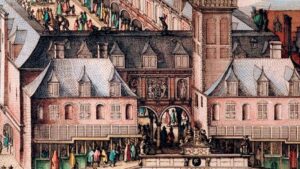
Hendrick de Keyser ExchangeThe Beurs van Hendrick de Keyser (Exchange of Hendrik de Keyser) was the first municipal Merchants Exchange in Amsterdam. The exchange building opened in 1611 after the city council concluded that having the exchange take place on the streets and in church buildings (see 1-4) was no longer appropriate for a world trade centre in the making. After the opening, the exchange’s floor was soon crowded with local merchants as well as foreign visitors.
The rectangular red-brick building was built on the south side of the Dam Square over the water of Rokin. The 'service entrance' was located on the Dam side. The main entrance and the tower, as can be seen in the picture, was the view of the exchange visitors when they entered the exchange building from the direction of the Munttoren (Mint Tower).
The building was still mainly used for the trading of goods. Each type of commodity had its own place, recognisable by numbered pillars around the inner courtyard. The trade in stocks took place just behind the main entrance on the Rokin side, and was granted extra space in 1668 after the bridge in the foreground was added to the building.
Initially, it was possible to sail under the building with the mast down. However, after the Spaniards tried to blow up the Beurs van Hendrick de Keyser in 1622 using a boat loaded with gunpowder, the canal was closed off.
However, the fact that the Merchants Exchange was built across the water continued to be a problem for the building. Due to persistent subsidence, the exchange traders regularly had to move to the Dam Square and the Nieuwe Kerk (see 7). Eventually, this situation proved fatal for the Beurs van Hendrick de Keyser. In 1835, it was decided to close the building and it was demolished two years later. Due, in part, to the poor economic situation, the traders had to make do with a makeshift building on the Dam Square for the almost ten years that followed (see 8). In today’s streetscape, apart from the Beurspoortje (see 6), nothing reminds us of this first illustrious exchange building in Amsterdam.
1611-1835Oude Kerk (Old Church)Around 1600, the Oude Kerk (Old Church) regularly served as a exchange location. As in the nearby Sint Olofskapel (see 3), merchants regularly sought shelter here when harsh weather conditions made trading on the Nieuwe Brug (see 2) impossible. Although there is no hard evidence, it is not unlikely that this is where the first VOC shares were passed around in the early 17th century. The 'Biblical abuse' came to an end in 1611 when Amsterdam built its first ever exchange building: the Beurs van Hendrick de Keyser (see 5).
1600 - 1611Nieuwe Brug en PaalhuisjeBetween 1561 and 1611, the Nieuwe Brug (New Bridge) and the adjacent Paalhuisje (Post House) was the second permanent exchange location in Amsterdam. Just like in the Warmoesstraat (see 1), traders met here in the open air and mainly traded goods. The location near the IJ-harbour was a logical choice. Skippers met there to deliver mail to the Paalhuisje and to pay their demurrage (berthing fee). However, there was also a disadvantage to the new location: it was very cold and bleak on the open water of the IJ. That is why the exchange regularly moved to close-by church buildings during this period (see 3 and 4).
The Paalhuisje has long since disappeared, but the Nieuwe Brug still exists. Coming from the Centraal Station (central station), it is the first bridge towards the Dam Square. The bridge is hardly noticeable in today's streetscape. Yet, historically speaking, it is a special place. Not only is it the origin of the centuries-old tradition of the beursgong (exchange gong), it is also the place where trade took place when the VOC laid the foundations for the world's first ever stock exchange in Amsterdam in 1602.
1561 - 1611Beurs van ZocherThe Beurs van Zocher (Zocher Exchange) is the second municipal Merchants Exchange in Amsterdam. After the capital's exchange community had had to make do with a temporary building on the Dam Square for ten years (see 8), it was finally granted a real exchange building again in 1845.
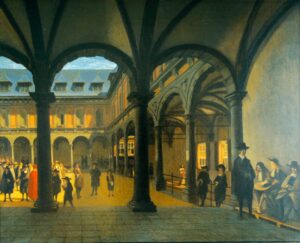
The exchange building stood on the site now occupied by the Bijenkorf department store. Entirely in keeping with the fashion of the time, architect Jan David Zocher designed a exchange building that closely resembled a Greek temple. Although it was very different in appearance, it looked very much like the Beurs van Hendrick de Keyser (see 5) on the inside. Once again, there was a rectangular courtyard surrounded by numbered pillars and covered passageways.
Just like before, the stock exchange took place amidst the goods trade and had its own 'corner' behind the main entrance on the Dam side. Three years after the opening, it was decided to cover the courtyard as well, as it would still be quite drafty. Nevertheless, complaints persisted, especially from the stock market. In the second half of the 19th century, the trade in stocks was booming and gradually surpassed the traditionally dominant trade in goods. This created a need, particularly among stockbrokers, for more space and preferably their own building.
This resulted in a thirty-year battle for better and larger accommodation. In 1903, the Beurs van Zocher was finally demolished and the third Merchants Exchange location was built in Amsterdam: the Beurs van Berlage (see 10).
1845 - 1903Sint OlofskapelIn 1586, the Amsterdam city council turned the vacant Sint Olofskapel (Saint Olof’s Chapel) into a shelter for the trading community. Because the weather at the permanent exchange location on the Nieuwe Brug (see 2) was often very bad, the chapel - later also called Oude Zijds Kapel (Old Side Chapel) - regularly served as a backup location from the end of the 16th century onwards.
The Catholic chapel had become vacant in 1578 after Amsterdam had sided with the rebels during the Eighty Years' War with Spain ('Alteration'). After the Sint Olofskapel was restored to its ecclesiastical glory in 1602, its use for trade was met with increasing objections. This eventually led to the city council's decision to build a real Merchants Exchange location: the Beurs van Hendrick de Keyser (see 5).
The remarkable thing about the Sint Olofskapel is that it still exists today. Coming from the Centraal Station, the chapel is located at the beginning of the Zeedijk on the right-hand side. Nowadays, the chapel is part of a hotel and serves as an events location.
WarmoesstraatThe Warmoesstraat was Amsterdam's first permanent exchange location. As early as 1493, this street was known as the place‘alwaer de Coopluijden dagelicx bi den anderen comen’ (the place where traders gather on a daily basis).The traders usually met on the street’s north side, close to the water of the IJ. As trade increased over the course of the 16th century, the local residents experienced more and more nuisance in this narrow, and at the time distinguished street. In 1561, the city council designated a new exchange location: the Nieuwe Brug (see 2).